Barry, Pugin and a tower built from the inside
Charles Barry designed the palace; Augustus Pugin gave the clock tower its look. It took sixteen years from foundation stone to bells.
Big Ben is the bell; the Elizabeth Tower is the tower. Dates and figures come from the sources linked beside them; where sources disagree, we show each one.
The architects
Entry 64 was by the architect Charles Barry. It had two towers: a grand royal entrance to the south and a smaller clock tower to the north. UK Parliament
Barry may have been inspired by old engravings that showed a clock tower standing in New Palace Yard in medieval times. UK Parliament
The clock tower in Barry’s original proposal was not the 96-metre tower we know. UK Parliament
Barry took inspiration from a clock tower at Scarisbrick Hall in Lancashire, designed by Augustus Welby Pugin, a young Gothic Revival architect who became Barry’s collaborator on the decorative details. UK Parliament
Under Pugin’s influence the clock tower grew in size and importance, with large clock dials under a tall, two-stage spire. UK Parliament
Pugin added the symbols of the four parts of the United Kingdom, the leek, thistle, rose and shamrock, alongside the Tudor portcullis and fleur-de-lys. UK Parliament
The portcullis, used all over the new palace, became the emblem of both the House of Commons and the House of Lords. UK Parliament
The tower designs were Pugin’s last important set of drawings. He died in 1852, aged only 40, and never saw the finished tower. UK Parliament
As he worked, Pugin wrote: “I never worked so hard in my life for Mr Barry for tomorrow I render all the designs for finishing his bell tower and it is beautiful.” UK Parliament
Historic England dates the new palace to 1835–60, by Sir Charles Barry, with detailing, interiors and furnishings by A. W. N. Pugin. Historic England
UNESCO notes that Westminster Abbey inspired Barry’s and Pugin’s Gothic Revival work on the palace. UNESCO
Built from the inside
The foundation stone of the clock tower was laid on 28 September 1843. UK Parliament
Materials came from all over: bricks from Hendon in Middlesex, stone from Anston near Sheffield, paving from Hopton Wood in Derbyshire, slate from the Preseli Hills in Pembrokeshire, and stone for the interior from Caen in Normandy. UK Parliament
Anston stone was chosen because it was cheaper, could be carved more elaborately, and was close to the Chesterfield Canal for transport to London. UK Parliament, 2021
The tower was built from the inside out: Londoners watched it rise with no workmen or materials in sight. UK Parliament
Steam-powered winches lifted materials up a shaft inside the tower, so no scaffolding was needed; a gantry on top was jacked up as the tower grew. UK Parliament
Sixty-one metres of brickwork faced with sand-coloured Anston stone went up before the two-tier iron spire was added. UK Parliament
Inside there was a stone spiral staircase in one corner, an air shaft to bring fresh air to the palace, and a weight shaft for the clock in the centre. UK Parliament
Low down there were rooms for prisoners, meaning MPs who broke the rules of the House of Commons, with document stores above. UK Parliament
Grissell and Peto built the tower up to the level of the clock dials; John Jay of London built the dials and roof section. UK Parliament
Jabez James of Lambeth made the roof ironwork, the great frame for the five bells and the four cast-iron dials. John Hardman of Birmingham did cast-iron details on the roof, and F. Crace & Son painted and gilded. UK Parliament
Building fell five years behind schedule, and Parliament moved into its new home before the tower was finished. From foundation stone to the first bells took sixteen years. UK Parliament
By the numbers
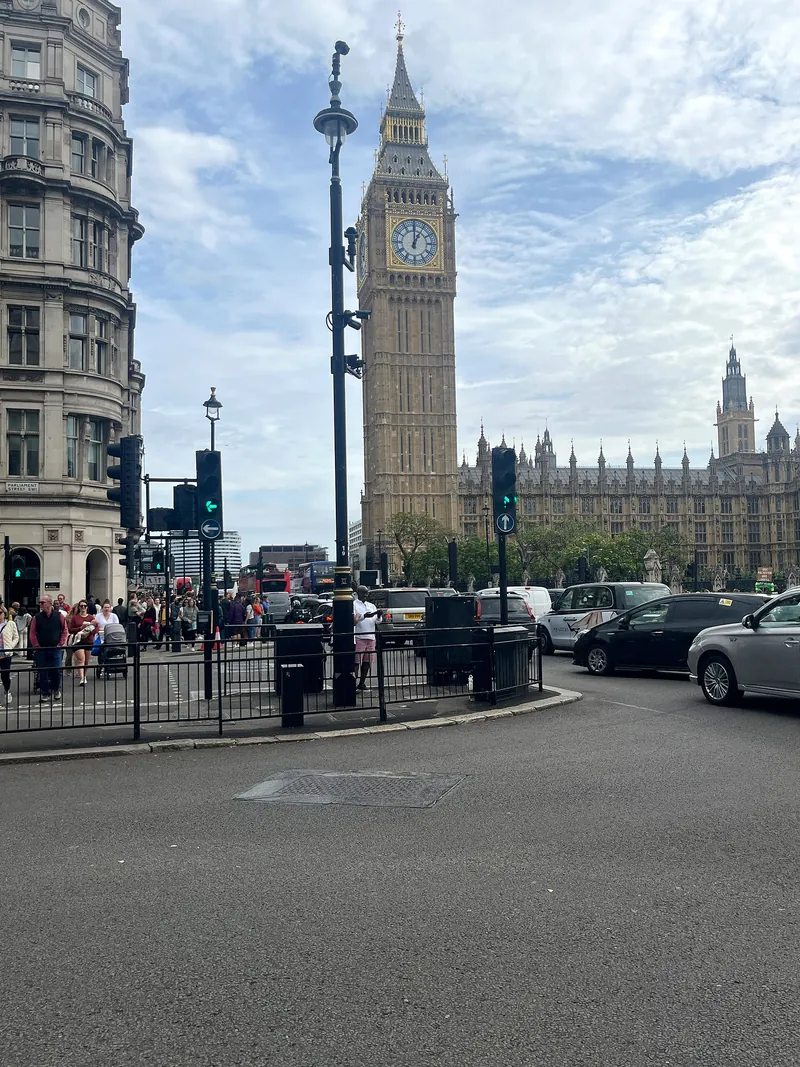
The Elizabeth Tower is 96 metres tall, with 11 floors; Parliament compares it to 21 London buses stacked on top of each other. UK Parliament, facts and figures
It is 281 steps up to the clock faces and 334 to the belfry, where Big Ben hangs. Another 65 steps take you to the Ayrton Light. UK Parliament, facts and figures
The tower contains about 850 cubic metres of stone and 2,600 cubic metres of brick: Anston stone from Yorkshire, Clipsham stone from Rutland and Caen limestone from France. UK Parliament, facts and figures
For all its height, the tower stands on a footprint of only 12 metres square. UK Parliament
The Ayrton Light
Acton Smee Ayrton, First Commissioner of Works from 1869 to 1873, had the idea of a light near the top of the tower to show when the House was sitting. UK Parliament
The light is said to have been put there at Queen Victoria’s request, so she could see from Buckingham Palace when Parliament was sitting after dark. UK Parliament, 2021
Parliament’s history page says the permanent Ayrton Light was installed in 1892 by J. Edmundson & Co., using a Wigham lighthouse lamp, and was first lit by gas. UK Parliament
The Ayrton Light went electric in 1903, and the dial lighting changed from gas to electricity in 1906. UK Parliament
From outside, look up: the Ayrton Light shines whenever either House is sitting. UK Parliament, 2022
When was the Ayrton Light installed? Sources differ
- Parliament’s history page says the permanent Ayrton Light was installed in 1892 by J. Edmundson & Co., using a Wigham lighthouse lamp, and was first lit by gas. UK Parliament
- A 2021 Parliament news story describes the Ayrton Light as a lantern-like structure installed in 1885, which shines whenever either House sits after dark. UK Parliament, 2021
The same 2021 news story that says 1885 also repeats the 1892 date for the permanent light, so the two may describe an earlier light and its permanent replacement. We have not found a source that says so directly.
What to call it
Big Ben is, strictly, the nickname of the Great Bell. The tower’s official name was simply the Clock Tower, but people all over the world call the whole thing Big Ben after the bell. UK Parliament
On 25 June 2012 the House of Commons Commission renamed the Clock Tower the Elizabeth Tower, for Queen Elizabeth II’s Diamond Jubilee, after a campaign backed by MPs across the House. UK Parliament
Queen Victoria had a similar honour: the big tower at the southern end of the Palace, the royal entrance, is the Victoria Tower. UK Parliament
Protected
The Houses of Parliament, including the Elizabeth Tower, are a Grade I listed building, first listed on 5 February 1970 (list entry 1226284). Historic England
Historic England’s list entry describes the clock tower at the end of New Palace Yard as virtually free-standing. Historic England
The Palace of Westminster, with Westminster Abbey and St Margaret’s Church, was inscribed as a World Heritage Site in 1987. UNESCO
UNESCO’s description of the World Heritage Site says the Palace, the clock tower and the sound of Big Ben have become internationally recognised symbols of Britain and democracy. UNESCO
Our view: the tower is Pugin’s as much as Barry’s. Barry planned a smaller clock tower; Pugin’s last drawings made it the one people recognise.
Next: the restoration →