Big Ben and the four quarter bells
Big Ben is one of five bells in the belfry. It took two castings, two cracks and a lighter hammer to get it right.
Big Ben is the bell; the Elizabeth Tower is the tower. Dates and figures come from the sources linked beside them; where sources disagree, we show each one.
Five bells
Barry’s plan needed bells: a Great Bell to strike the hours and four smaller quarter bells to chime every fifteen minutes. UK Parliament
None of the bells swings. They hang fixed and are struck from outside by hammers, not by clappers inside. UK Parliament, facts and figures
The quarter bells weigh 1.1, 1.3, 1.7 and 4 tonnes. UK Parliament, facts and figures
The notes: Big Ben is E; the quarter bells are G, F sharp, E and B. UK Parliament, facts and figures
Denison chose the tune for the quarter bells: the ‘Cambridge Quarters’, from the church of Great St Mary’s in Cambridge. UK Parliament
The first Big Ben
John Warner’s foundry near Stockton-on-Tees cast the first Great Bell in August 1856, and his firm cast the four quarter bells at Cripplegate in London later that year. UK Parliament
The bell was originally to be called ‘Royal Victoria’. UK Parliament, key dates
The new bell came by rail and sea and was pulled across Westminster Bridge by 16 white horses. UK Parliament
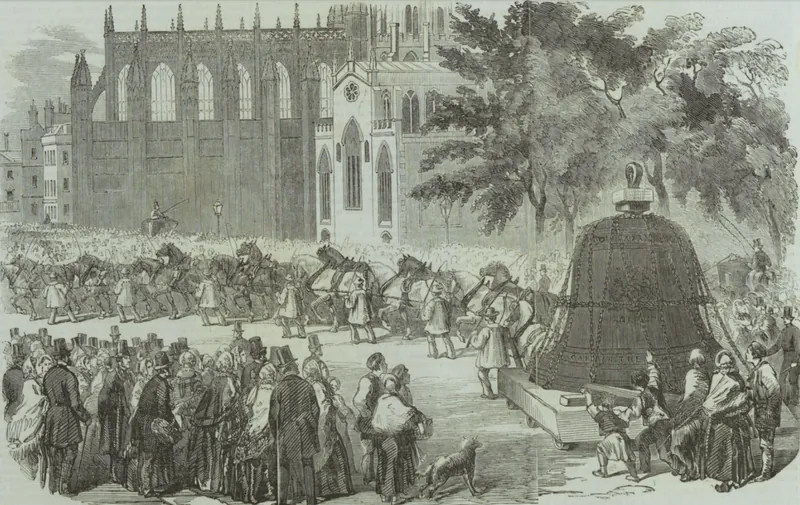
In December 1856 the first test hammer, tried in New Palace Yard, was described as weighing “nearly, or quite, a half ton”. Word Histories
Denison wanted the loudest sound possible and used a huge hammer. The bell was tested daily until 17 October 1857, when a crack 1.2 metres long appeared. The hammer was too heavy. UK Parliament
Warners, who made the bell, and Denison, who designed the clock, argued over who was to blame. UK Parliament, key dates
The second Big Ben
The cracked bell was melted down and recast by George Mears at the Whitechapel Bell Foundry on 10 April 1858. That second bell is the one in the tower today. UK Parliament
Parliament’s clock-history page says the new bell weighed 13.5 tonnes, 2.5 tonnes lighter than the first. UK Parliament
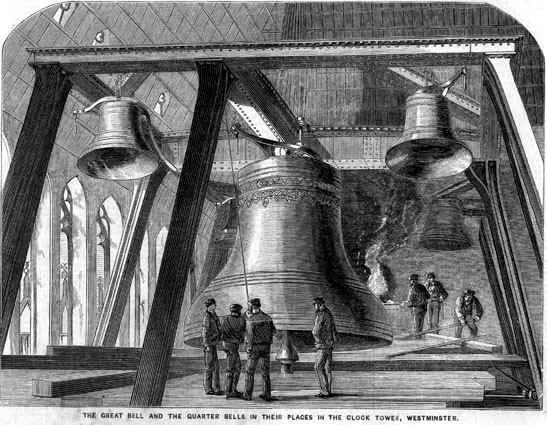
To get it into the belfry, the bell was turned on its side and winched up the ventilation shaft. It took 30 hours. UK Parliament
Cracked again
Big Ben rang out for the first time on 11 July 1859. In September it cracked too, and for four years the largest quarter bell struck the hours instead. UK Parliament
Airy’s fix: turn the bell 90 degrees so the hammer hits a different spot, and fit a lighter hammer. A small square was cut out to stop the crack spreading. The crack and the hole are still visible. UK Parliament
The fix was made in 1863, and Big Ben struck the hours again. UK Parliament, key dates
Struck by the lighter hammer, the Great Bell gives what Parliament calls a soulful E. UK Parliament
How heavy is Big Ben?
Big Ben’s weight: sources differ
- Parliament’s facts page gives Big Ben’s weight as 13.7 tonnes, with a 200-kilogram hammer. UK Parliament, facts and figures
- Parliament’s 2017 announcement also gives 13.7 tonnes, and says the bell strikes the hour on the note E. UK Parliament, 2017
- Parliament’s clock-history page says the new bell weighed 13.5 tonnes, 2.5 tonnes lighter than the first. UK Parliament
All three are Parliament pages. The difference is small, and none of them says how the bell was weighed, so we give both figures. The 200-kilogram hammer is the figure on today’s facts page; the hammer that cracked the bells was replaced by a lighter one.
Why “Big Ben”?
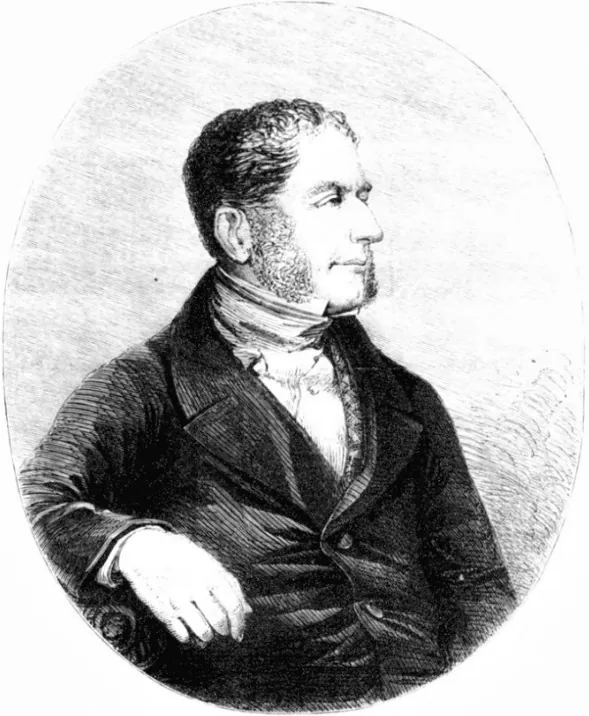
On 22 October 1856 The Times reported that the bell had arrived and that it was proposed to call it “Big Ben” in honour of Sir Benjamin Hall, then in charge of public works. Word Histories
Benjamin Hall (1802–67) was a Welsh politician and civil engineer, First Commissioner of Works from 1855 to 1858. Word Histories
Parliament says the bell was probably named after Sir Benjamin Hall in fun, because he was a tall man. UK Parliament
Another theory links the name to the bare-knuckle boxing champion Ben Caunt, also known as ‘Big Ben’; HISTORY calls Hall the most likely source. HISTORY
Hall’s name is inscribed on the bell. HISTORY
Who was Big Ben named after? Sources differ in tone
- On 22 October 1856 The Times reported that the bell had arrived and that it was proposed to call it “Big Ben” in honour of Sir Benjamin Hall, then in charge of public works. Word Histories
- Parliament says the bell was probably named after Sir Benjamin Hall in fun, because he was a tall man. UK Parliament
- Another theory links the name to the bare-knuckle boxing champion Ben Caunt, also known as ‘Big Ben’; HISTORY calls Hall the most likely source. HISTORY
The Times in 1856 says the name honoured Hall; Parliament says it was probably given in fun; the boxer Ben Caunt is a theory, and the HISTORY article prefers Hall. None of the sources we read cites a document linking the name to the boxer.
When Big Ben is silent
Recast in 1716, that bell later hung in the south-west tower of St Paul’s, and if Big Ben is ever unable to strike, the St Paul’s bell is heard instead. UK Parliament, key dates
The hour bell has been tolled slowly to mark the deaths of four sovereigns: Edward VII, George V, George VI and Elizabeth II. For Sir Winston Churchill’s funeral, the bells were silent as a mark of respect. UK Parliament
BBC Radio first broadcast the chimes across the UK on New Year’s Eve 1923, and in 1932 the Empire Service carried them abroad for the first time, in King George V’s Christmas broadcast. UK Parliament, key dates
Our view: the second bell’s crack, the square cut out of it and the quarter turn are the best part of the story. The sound the world knows is the sound of a repair.
Next: the Great Clock →