2017–22: the biggest repair in the tower’s history
For five years the tower was wrapped in scaffolding and Big Ben was mostly silent. Here is what was done, who did it and what it cost.
Big Ben is the bell; the Elizabeth Tower is the tower. Dates and figures come from the sources linked beside them; where sources disagree, we show each one.
Why it was needed
By the 2010s the tower had the problems of any building its age: crumbling stone, rusty ironwork, leaking roofs and an ageing clock. UK Parliament
The last big repairs had been in 1983–85. UK Parliament
Pollution had badly damaged the stone, and the black paint around the dials had stopped the stonework from breathing. UK Parliament
Decades later, modern surveys found fractures and structural damage that could not be detected with the methods of the 1940s and 1950s. UK Parliament
The project was separate from the wider Restoration and Renewal programme for the Palace, because a feasibility study showed the tower could not wait. UK Parliament
The bongs stop
Parliament announced that the bongs would sound for the last time before the works at noon on Monday 21 August 2017. UK Parliament, 2017
Parliament said Big Ben had marked the hour with almost unbroken service for 157 years. UK Parliament, 2017
The bongs stopped after the 12 noon chimes on 21 August 2017; the striking was paused to protect the people working in the tower. UK Parliament
After concerns from a number of MPs, the House of Commons Commission said it would consider how long the bells would be silent. UK Parliament, 2017
Parliament’s clock mechanics still made sure Big Ben could strike for New Year’s Eve and Remembrance Sunday. UK Parliament
One clock face was kept visible at all times so people could still set their watches by it. UK Parliament, 2017
From 2017 an electric motor drove the hands on the visible dial while the real mechanism was away. UK Parliament, 2021
The scaffold
The contract went to Sir Robert McAlpine Ltd in September 2017. UK Parliament, 2017
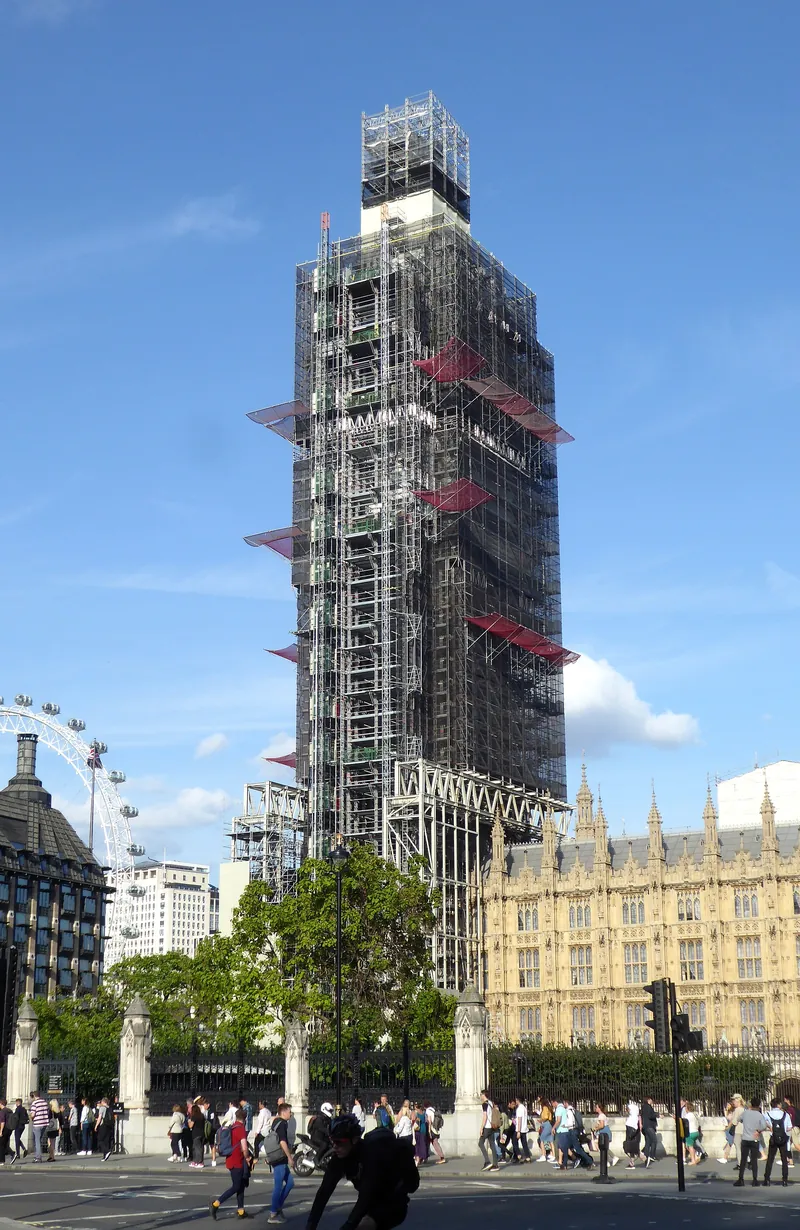
It took six months to put up one of the most complex scaffolds in British history. It was free-standing, built around the tower without touching the stonework. UK Parliament
A note to the Commons Finance Committee calls it the largest free-standing scaffold in Europe. Finance Committee note
Once the scaffolding was up, it soon became clear that the damage was much worse than expected. UK Parliament
The survey found decayed carvings, asbestos in the belfry, extensive toxic lead paint and broken glass in the dials. BBC News, 2020
Stone and iron
Replacement stone came from a quarry near Doncaster, and each new piece took a stonemason at least two weeks to carve by hand with traditional tools. UK Parliament
By early 2020, 700 stone repairs had been needed, 300 more than first estimated. BBC News, 2020
The Finance Committee note says the stonework turned out to be more than four times what had been allowed for. Finance Committee note
Wartime bomb damage had hurt the roof’s cast-iron frame. All 3,343 pieces of the roof were taken off to a workshop, and new pieces were cast by hand at a foundry in Halifax. UK Parliament
That foundry was Hargreaves Foundry, and its ‘HF’ stamp can be seen on metalwork across the tower. UK Parliament, 2021
Every piece of the Ayrton Light was taken down and restored by Shepley Engineers in Sheffield. UK Parliament, 2021
Back to blue
Paint experts from the University of Lincoln analysed more than 160 years of paint on the tower and found six different colour schemes. UK Parliament
The familiar black around the dials was probably chosen in the 1930s to hide the effects of pollution. UK Parliament
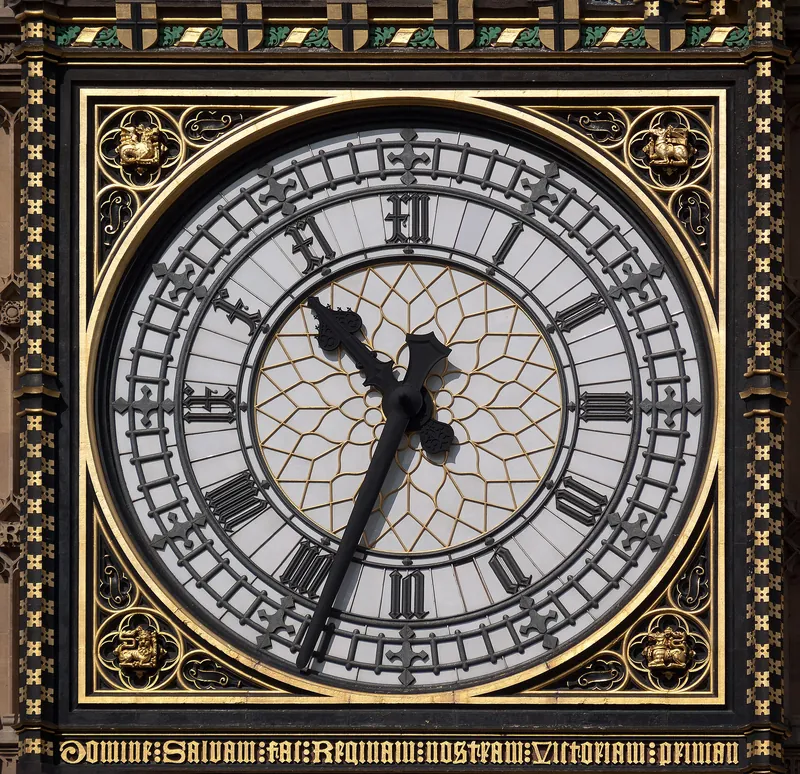
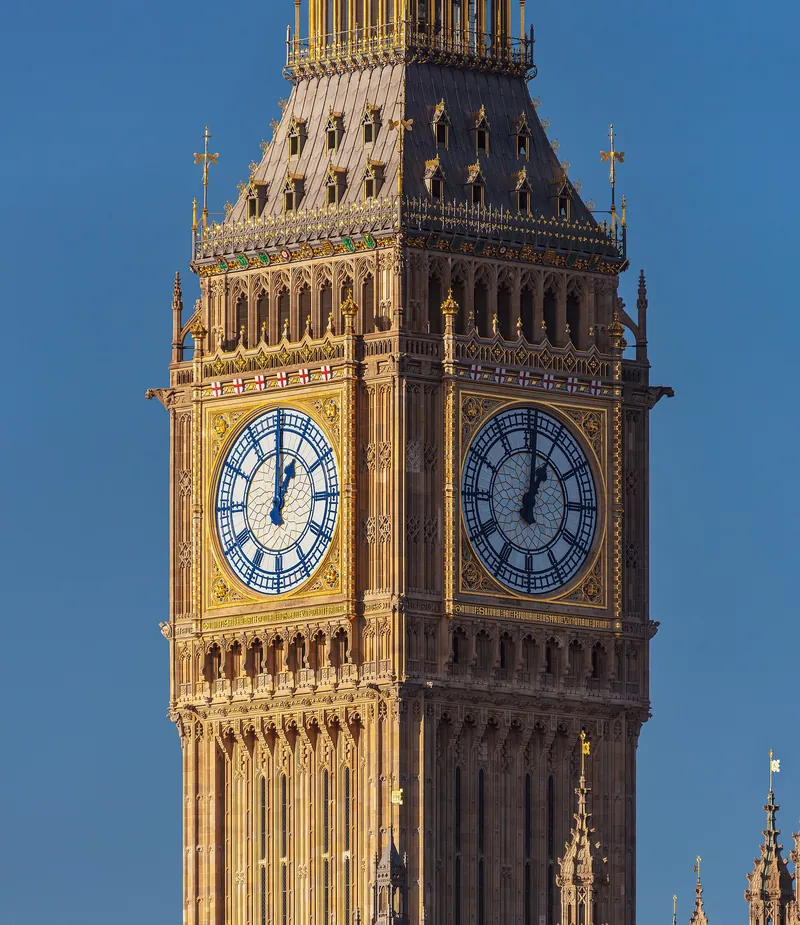
The restored dials and hands are Prussian blue and gold, as in Barry’s design, with the red, white and blue of the Union flag around them. UK Parliament
Above each dial a row of six shields shows St George’s red cross on white again. UK Parliament
On the roof, the shamrock and leek are green again, the thistle green with a purple head, and the rose red and white. UK Parliament
The regilded areas closely match those first gilded in 1859. UK Parliament
The North Dial was the first finished, in 2019, in the original Prussian blue and gilt. UK Parliament, 2019
All 1,296 pieces of glass in the four dials were replaced with mouth-blown pot opal glass, cut and fitted by hand by stained-glass specialists from South London. UK Parliament
The original hands came back in 2021, three years after they were taken down for conservation. UK Parliament, 2021
The clock goes to Cumbria
For the first time in its history the clock was dismantled, winched 53 metres down and taken away for a complete overhaul. Parliament’s conservation page calls it the 12-tonne clock. UK Parliament
The bell itself stayed where it was: Big Ben remained in the tower throughout the works. UK Parliament, 2019
The Cumbria Clock Company restored more than 1,000 clock parts at its workshop in Dacre, near Penrith. It was the first time the whole mechanism had left the tower. UK Parliament, 2021
Neither Denison nor Dent kept detailed records of how the clock was built, so the company produced the first user manual and engineering drawings of the mechanism. UK Parliament, 2021
For two years the clock’s ‘heartbeat’, its timekeeping side, ticked away on test in the company’s workshop. UK Parliament, 2021
The automatic winding mechanism fitted in 1912, parts of which were thought lost, was rebuilt. UK Parliament
Ian Westworth, one of Parliament’s clock mechanics: “This was the first time the Great Clock has been taken apart fully so we can assess and repair every wheel and pinion.” UK Parliament
The Finance Committee note says it had been assumed Parliament’s own clock mechanics would do the clock work, but they did not have the capacity; the change cost about £2 million. Finance Committee note
The four different weights given for the clock are compared on the clock page.
New, not just repaired
New work included a lift for maintenance and emergency access, and LED lighting, including in the Ayrton Light. UK Parliament
A glass box at the top of the stairs now gives visitors a much better view of Big Ben and the quarter bells. UK Parliament
More than 500 people from across the UK worked on the project, in trades from stone masonry and glass blowing to gilding, plastering, cast iron and clock mechanics. UK Parliament tours
Big Ben is back
Big Ben’s official return came at 11 am on Remembrance Sunday, 13 November 2022, striking eleven times for the Two Minutes’ Silence. UK Parliament, 2022
After five years, the bells returned to regular service in November 2022, following four days of tests. UK Parliament, 2022
At that point the outside was finished, and the main contractor was to stay on site until December 2022, with visitors expected back inside in 2023. UK Parliament, 2022
When did the restoration finish? Sources differ
- Parliament’s key-dates page says the conservation was completed in 2022. UK Parliament, key dates
- At that point the outside was finished, and the main contractor was to stay on site until December 2022, with visitors expected back inside in 2023. UK Parliament, 2022
- The Finance Committee note gives the actual project completion as October 2023, including nine months of Covid impact. Finance Committee note
- In 2019 the project was due to finish in 2021. UK Parliament, 2019
The bells were back and the outside finished in late 2022, which is the date Parliament’s history pages use. The Finance Committee note counts the whole project, inside work included, as complete in October 2023. Back in 2019 the end date was expected to be 2021.
What it cost
In spring 2016 the feasibility study estimated £29 million. By September 2017 the estimate was £61 million, including VAT, risk allowances and £4.5 million of fire-protection work moved in from another project. UK Parliament, 2017
In February 2020 the budget rose by £18.6 million to £79.7 million, after the discovery of bomb damage and asbestos. BBC News, 2020
A further £9 million was set aside for the effects of Covid-19, including a four-month site closure in 2020. Written answer, 2022
The Finance Committee note gives a total approved budget of £89 million and a final outturn cost, including Covid, of £85.5 million. Finance Committee note
The design consultant was Purcell Architecture and the main contractor Sir Robert McAlpine. Finance Committee note
Our view: the bill more than doubled because nobody could see the damage until the scaffold was up, which is what the Finance Committee note says too. The result, a tower in its 1859 colours, looks worth it to us.
Next: visiting today →